M. Lemoine
The Secret of ChimneysM. Lemoine, a detective of the Paris Sûreté, is Superintendent Battle’s expected French colleague in the investigation at Chimneys. His role turns on the gap between official identity and apparent identity: the genuine detective first works undercover, while a criminal later impersonates him. The resulting confusion helps the investigation preserve its advantage and expose King Victor’s scheme.
Identity and Introduction
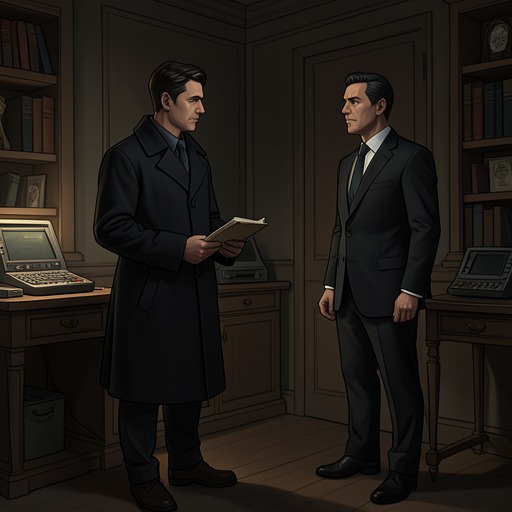
Battle has been told from Paris that M. Lemoine is coming to assist him, but he cannot initially account for the detective’s failure to appear. At Chimneys, a suspicious French-speaking stranger identifies himself to Battle as a representative of Scotland Yard and offers to present his credentials. Battle then explains that this man is the colleague they have been expecting, M. Lemoine of the Sûreté in Paris. The delayed introduction is deliberately misleading: the stranger Battle welcomes under that name is not the genuine detective.
The confusion is prepared by the presence of a man calling himself M. Chelles, a French traveller in silk staying at the Cricketers. His actions strike Battle as suspicious, although the evidence does not immediately establish who he is or what he intends. The false identity of the supposed French colleague therefore sits within a wider pattern of disguises and uncertain affiliations, rather than appearing as a simple administrative mistake.
The Genuine Detective’s Method
The real M. Lemoine arrives on the morning after Prince Michael’s murder. Instead of announcing himself to Battle and investigating as an official colleague, he decides to observe events unofficially. He believes this approach offers greater possibilities: if he appears suspicious, the people he is pursuing may be less likely to recognize him as an investigator and take precautions. He later says that, during his two days of covert observation, he has seen a good deal of interest.
That choice explains why Battle cannot find him when expected and why the supposed French detective’s conduct remains ambiguous. The genuine M. Lemoine accepts suspicion as a useful cover, turning a liability into an investigative method. His late disclosure also means that the people at Chimneys have had to interpret the stranger’s actions without knowing that he is secretly conducting an inquiry.
Partnership with Battle and the Investigation
Once his identity is established, M. Lemoine joins Battle’s investigation. Battle has been asking why his French colleague has not appeared, and the explanation makes clear that the two detectives’ work has overlapped even while their methods differed: Battle has been investigating openly in his official role, while M. Lemoine has gathered observations without presenting himself as the expected partner.
Battle’s response to the uncertainty is to keep the people at Chimneys under scrutiny and to seek cooperation rather than allow the investigation to be governed by political secrecy. When Virginia argues that the secret cannot be maintained indefinitely, Battle says that Anthony Cade has been drawn into the affair and deserves to know the facts. M. Lemoine agrees with her. His assent places him on the side of disclosure to those whose involvement affects the inquiry, though the evidence does not show him independently revealing the political information at that moment.
The collaboration ultimately gives Battle’s official investigation and M. Lemoine’s covert observations complementary roles. Battle’s suspicion of the man posing as his colleague proves consequential: he has already asked Paris for the real detective’s fingerprints and Bertillon measurements. The investigation thus treats identity not as a matter of confident self-presentation, but as a claim that can be tested against records and physical particulars.
The Impostor and the Identification Trap
Near the end of the investigation, a man with a neat black beard, eyeglasses, and a bandage around his head is presented as the real M. Lemoine of the Sûreté. His appearance confirms that the detective previously encountered at Chimneys was an impostor. In the subsequent explanation, Anthony Cade describes the underlying pattern: a genuine person had been kidnapped, and a false one had taken his place. The same device, he says, explains this case, with King Victor himself acting as the false M. Lemoine.
Battle’s request to Paris for the genuine detective’s identifying information becomes the countermeasure. M. Lemoine explains that he has received King Victor’s fingerprints and Bertillon measurements from France and arranged for them to be sent to Chimneys. The information concerns King Victor, also known as the so-called Captain O’Neill, and is intended to determine whether Anthony is the man under suspicion. The identification process is therefore part of a broader test of competing identities, not merely a routine check of the French detective’s credentials.
The false M. Lemoine also exploits the gathering at Chimneys to protect a diamond theft. After Anthony gives a misleading clue about the jewel’s location, the impostor writes a note and has Tredwell deliver it upstairs to Mademoiselle Brun. He then accuses Anthony of being King Victor, creating a diversion that keeps the others in the room while his accomplice can act. The false detective’s authority is thus instrumental: it lets him control attention and movement while passing instructions to his accomplice.
The real M. Lemoine’s arrival and the pending Paris identification records help close the trap. Anthony recognizes that the detective’s note is connected to fingerprints and Bertillon measurements, and later explains how the apparent identity test and the diversion fitted together. The impostor’s claim to be M. Lemoine does not survive the exposure of the real detective and the investigation’s access to official identifying information.
Narrative Role and Significance
M. Lemoine’s importance lies partly in the way his absence becomes an active clue. Battle expects a colleague from Paris, cannot explain the delay, and must assess a suspicious man who appears to fill the vacant role. The eventual distinction between genuine detective and impostor turns that uncertainty into a plot mechanism: official appearance can be counterfeited, but the investigation can still challenge it through observation, international communication, and identification records.
His covert work also reinforces the story’s repeated tension between disclosure and concealment. M. Lemoine withholds his official status to avoid warning those he is pursuing; King Victor adopts that status to misdirect the people around him. The same outward disguise therefore serves opposite purposes. One conceals an investigator so he can observe; the other borrows an investigator’s authority to manipulate a room and assist a theft. In the resolution, the distinction becomes legible through corroboration rather than appearance alone.